What Is a Business Management System — and Why Does a Construction Business Need One?
A Business Management System is much more than a folder of procedures or a piece of software. It is the operating framework that connects people, processes, controls, evidence and performance across a construction business.
Nov 3, 2026
Business Management Systems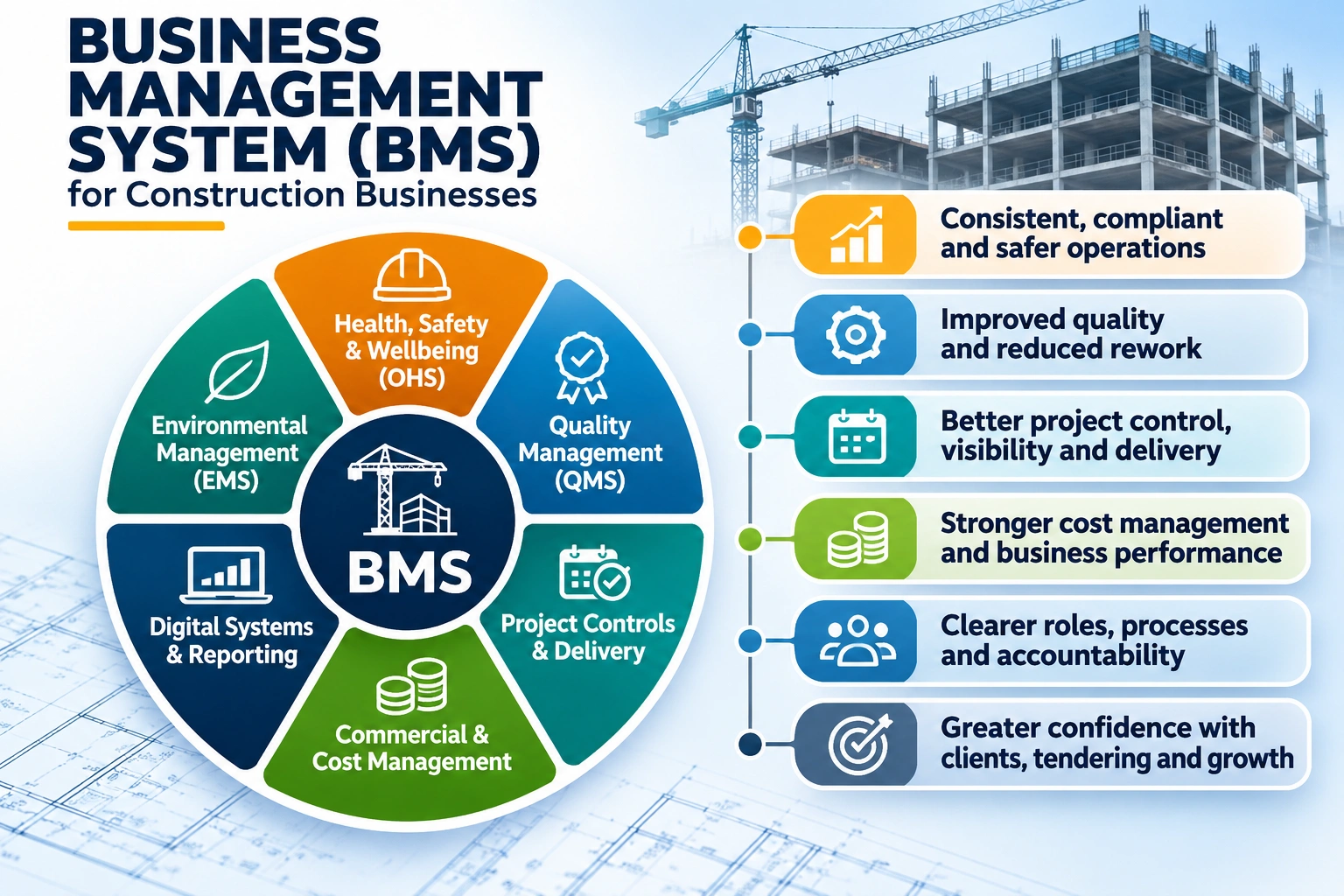
A Business Management System is much more than a folder of procedures or a piece of software. Done properly, it is the operating framework that connects people, processes, controls, evidence and performance across a business.
For construction companies, that matters because projects are complex. Multiple teams, subcontractors, suppliers, clients and stakeholders need to work within a consistent framework while managing commercial, programme, quality, safety and environmental obligations.
What is a Business Management System?
A Business Management System, or BMS, is the coordinated framework a company uses to plan, deliver, control, monitor and continually improve its operations.
It typically brings together:
• Policies and procedures
• Roles, responsibilities and authorities
• Project delivery processes
• Quality management
• Work health and safety
• Environmental management
• Commercial and contract controls
• Procurement and subcontractor management
• Programming and project controls
• Document and records management
• Risk and opportunity management
• Performance measures and reporting
• Continual improvement
• Supporting digital systems and technology
The objective is not simply to create documentation. It is to establish a practical and repeatable way of operating.
A BMS is not just a set of procedures
One of the most common problems is that businesses develop manuals, procedures and templates but do not fully integrate them into day-to-day operations.
A procedure sitting in a folder does not, by itself, create control.
A working management system should make it clear:
• What needs to happen
• Who is responsible
• When it needs to happen
• What approvals are required
• What records need to be retained
• How performance is measured
• How problems are escalated and corrected
The system becomes effective when people actually use it consistently across projects and business functions.
Why does this matter in construction?
Construction businesses often grow quickly.
A contractor may start with a small team where decisions are made informally, and key information sits with a handful of experienced people. That approach can work while the business is small.
It becomes increasingly difficult as the organisation takes on more projects, larger contracts, additional employees and more demanding clients.
Without consistent systems, common problems begin to appear:
• Different projects operate in different ways
• Responsibilities become unclear
• Important records are difficult to locate
• Commercial and contractual requirements are missed
• Programme information is inconsistent
• Quality evidence is incomplete
• Lessons learned are not carried between projects
• Management has limited visibility of performance
• The business becomes dependent on individual knowledge
A well-designed BMS reduces that dependency by creating a common operating model.
What are the benefits?
Consistency
Teams work to repeatable processes instead of reinventing the way projects are managed every time.
Accountability
Roles, responsibilities, approvals and escalation paths are clearly defined.
Risk reduction
Contractual, quality, safety, environmental, commercial and operational risks can be identified and controlled systematically.
Better decision-making
Management receives reliable records, dashboards, programme information and performance measures rather than relying on assumptions.
Tender and audit readiness
A structured system helps demonstrate that the business has appropriate controls, records and continual-improvement processes when responding to clients, prequalification requirements or certification audits.
Scalability
New employees and project teams can be brought into a common operating framework much more quickly.
Efficiency
Duplicate processes, unnecessary administration and fragmented systems can be identified and reduced.
Where does software fit?
Software can be an important part of a Business Management System — but software is not the BMS.
A company can implement sophisticated platforms and still have poorly defined processes.
The correct sequence should be to understand how the business needs to operate, define the processes and controls, and then select technology that supports those requirements.
Otherwise, businesses can end up adapting their operations to suit software rather than selecting software that supports the way the business needs to work.
Technology should enable the management system, not define it.
Does every business need the same system?
No - A management system should be proportionate to the organisation.
A small contractor does not need the same level of complexity as a national Tier 1 business. Over-engineering a system can create unnecessary administration and discourage people from using it.
The objective is to develop the right level of control for the organisation's size, risk profile, clients and future ambitions.
For some businesses, that may mean strengthening several priority areas first.
For others, it may mean developing an integrated system covering quality, safety, environment, project delivery, commercial management, procurement, programme controls and corporate governance.
When should a construction business review its BMS?
Typical triggers include:
• Rapid business growth
• Moving into larger or more complex projects
• Entering government, infrastructure, rail or Defense markets
• Client prequalification requirements
• Preparing for ISO certification
• Recurring project delivery problems
• Inconsistent project reporting
• Poor document or records control
• Heavy reliance on individual employees
• Implementing new business software
• Increasing contractual or compliance obligations
The earlier these issues are addressed, the easier it is to establish consistent ways of working before poor practices become embedded.
The objective is a system people actually use
A good BMS should make running a construction business easier — not add unnecessary bureaucracy.
The best systems are practical, understandable and closely aligned with how projects are actually delivered.
They provide management with better visibility, give project teams clearer expectations and create evidence that the organisation is operating in a controlled and repeatable way.
CPS Management works with construction businesses to assess, design and improve practical management systems covering project delivery, controls, assurance, digital enablement and accreditation readiness.
The focus is not simply on producing documents. It is on creating systems that work in practice.